
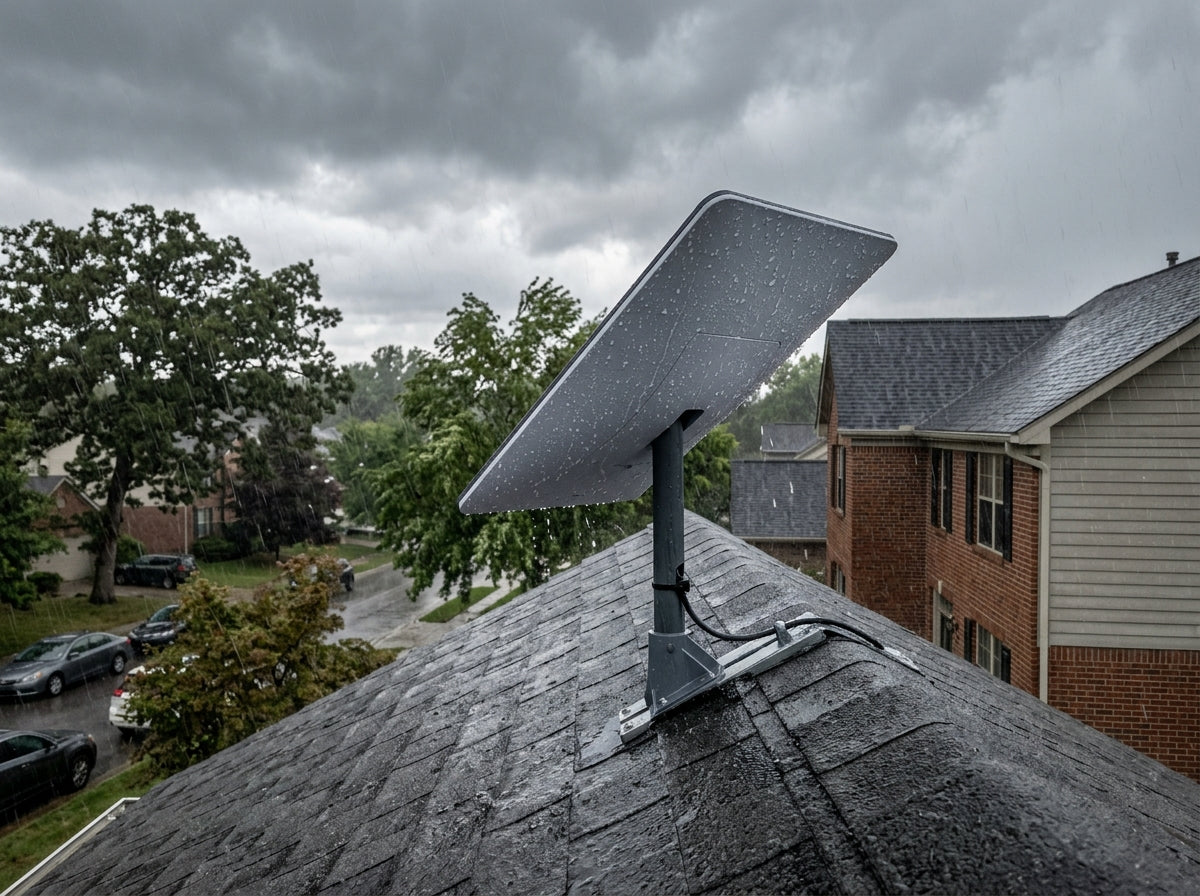
Does Starlink Work on Rainy Days? Here's What Australian Users Need to Know
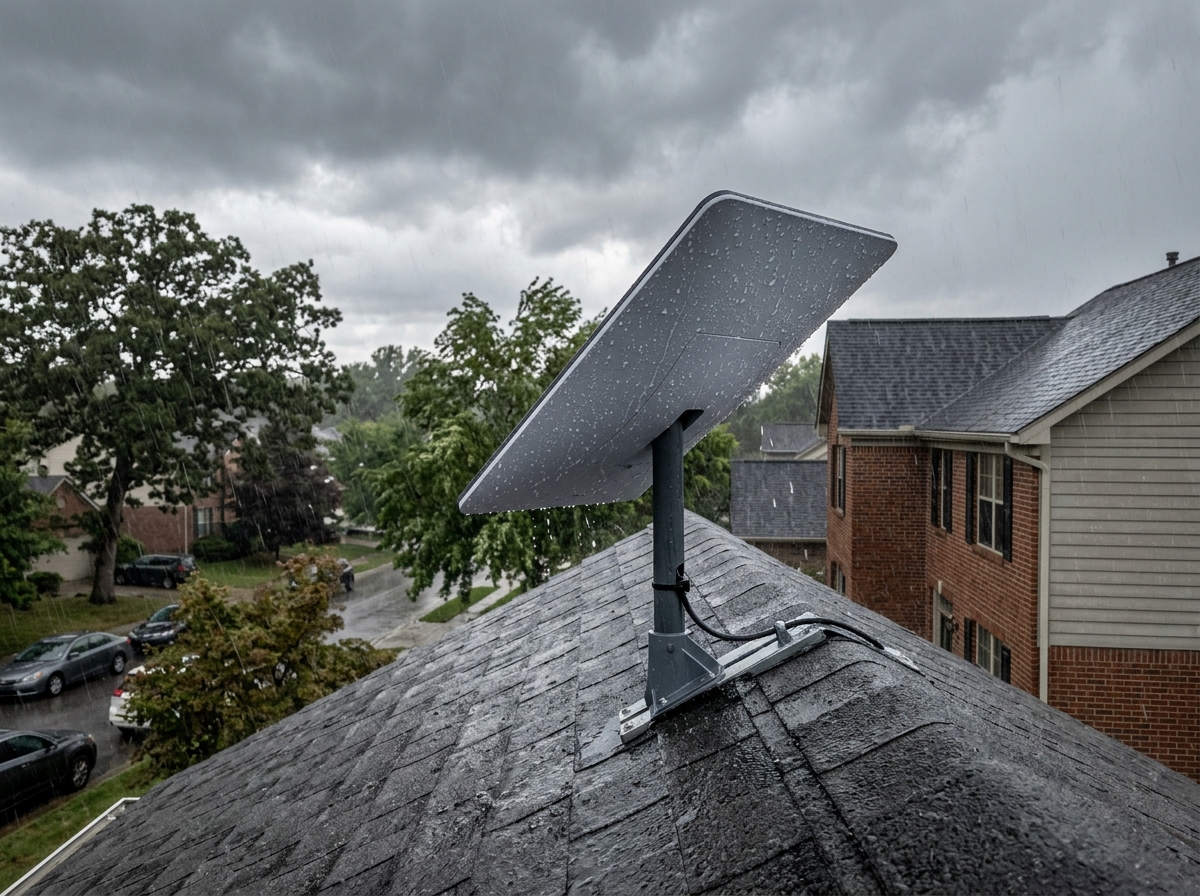
Does Starlink work on rainy days? Totally fair question. The good news is, for most users, it keeps running smoothly through light to moderate rain without any major drop in performance.
That said, heavy downpours can temporarily reduce speeds or cause brief dropouts lasting seconds to minutes. Here's a quick summary of what to expect:
- Light rain or drizzle: Virtually no impact on speeds or stability
- Moderate rain: Minor speed reductions, typically well within usable range
- Heavy rain or storms: Uplink speeds can drop by up to 52%, download by around 38% — recovering quickly once intensity eases
- Thick storm clouds (up to 87.5% cloud cover): Around a 20% speed reduction compared to clear conditions
- Outage duration: Most rain-related interruptions last only seconds to minutes
Starlink's low Earth orbit (LEO) design gives it a significant advantage over traditional satellite services. Because its satellites orbit at roughly 550 km (compared to 35,000 km for older geostationary systems), the signal travels a much shorter path through the atmosphere. Less atmosphere means less moisture for the signal to fight through.
But in real-world Australian conditions, performance isn't just about the technology itself.
How the dish is installed, its elevation, alignment, and how securely it's mounted, plays a major role in how well it holds up when the weather turns.
In coastal Queensland, alpine Victoria, or the cyclone-prone Northern Territory, a poorly secured dish can shift in high winds, lose alignment, and drop out even when the Starlink network itself is performing fine.
Does Starlink Work on Rainy Days?
The real question on rainy days is rain fade. That means the satellite signal gets weaker because water in the air can absorb or scatter parts of it before it reaches your dish. Starlink uses Ku-band and Ka-band frequencies, which help deliver fast internet, but they are also more sensitive to moisture than lower-frequency signals. In plain English: yes, Starlink usually still works in rain, but heavy downpours can reduce signal strength and cause slower speeds or brief dropouts.
According to official Starlink support documentation, significant weather can cause service degradation. However, the system is engineered to be far more resilient than the satellite TV or internet of the past. If you find your connection dropping out frequently during storms, the primary fix is ensuring your physical mount is stable. It is worth checking our troubleshooting tips for stormy weather to ensure your SpaceTek mount is providing the necessary rigidity to maintain a lock.
Understanding how Starlink works on rainy days during heavy downpours
During a true Aussie gully-washer, the sheer volume of moisture in the air creates a barrier. Research indicates that during heavy downpours, uplink speeds—the data you send out—can be reduced by about 52%. Download speeds usually fare better but can still see a 38% reduction.
This happens because the water molecules cause signal scattering. Instead of a direct "line of sight" beam between your dish and the satellite, the signal bounces around. The more intense the rain (typically over 25 mm/hr), the more atmospheric interference occurs. Despite this, most users find that even with these reductions, they can still browse the web or stream video, though high-stakes activities like competitive gaming might suffer from latency spikes.
You can read more about Starlink performance in Australian conditions to see how it handles our unique climate.
Why Starlink works on rainy days better than traditional satellite
If you’ve ever used older GEO (geostationary) satellite internet, you’ll know bad weather could really mess with your connection. Starlink is a different beast.
Traditional satellites sit about 35,786 km away, while Starlink satellites orbit much closer at around 550 km. That shorter distance means the signal travels through less atmosphere, which helps reduce the impact of rain and other weather.
Starlink also uses phased-array technology. Instead of locking onto a single satellite with a fixed beam, the dish can electronically track and switch between multiple satellites in real time. So if conditions aren’t great in one direction, it can often adjust quickly to maintain a stable connection.
That said, heavy rain can still cause slowdowns or brief dropouts, it’s just generally less severe compared to older satellite systems.
Maintaining Reliability During Australian Storms
While the software and satellites do the heavy lifting, the hardware on your roof has to survive the elements. Starlink dishes are rated to withstand winds up to 75 mph (120 km/h), which covers Category 1 cyclone conditions. However, the dish's ability to stay connected depends entirely on its stability. For those in the southern states or alpine regions, it's also vital to be preparing your system for winter weather to handle sleet and snow alongside the rain.
Why mounting stability is critical for signal consistency
This is where many DIY installations run into trouble. Starlink requires incredible precision to maintain its connection with satellites moving at 27,000 km/h overhead. If your mount is flimsy or vibrates in the wind, that tiny amount of movement can cause "micro-dropouts."
During a storm, wind often accompanies rain. If your dish is swaying even a few millimetres, the phased-array antenna has to work twice as hard to maintain alignment. A high-quality, rigid SpaceTek mount reduces vibration and ensures structural integrity. We have seen many cases where a user blames "rain fade" for a dropout, but the real culprit was a loose bracket. For those looking to tidy up their indoor gear against the elements, a moulded plastic wall mount holder can keep your power supply and router secure and off the floor.

Protecting your hardware from moisture and surges
The Starlink dish is designed for the outdoors, but the connectors are the vulnerable points. If you are setting up a mobile or temporary kit, moisture can find its way into the proprietary plugs. Always ensure your cables are fully seated. If they do get wet, dry them completely before reconnecting.
Lightning is another major factor during rainy storms. While the dish has basic built-in protection, a direct strike can fry the electronics. We always recommend using surge protectors. If you are running a Starlink Mini on the go, using a USB-C to DC cable or a 12-24V cigarette power adapter allows you to run your system from a portable power station or vehicle battery, which can be safer than being tethered to a grid-connected wall outlet during a lightning storm.
Starlink Weather Performance: Key Questions Answered
Does cloud cover affect Starlink?
Light to moderate cloud cover has zero noticeable impact. Very dense, moisture-heavy storm clouds can cause a slight dip in speeds (around 20%), but you’ll rarely lose connection entirely just from clouds.
What about fog and mist?
Similar to rain, heavy fog can cause some signal attenuation, but because fog droplets are much smaller than raindrops, the impact is usually negligible.
Can the dish handle extreme heat after the rain?
Yes, Starlink is rated for temperatures up to 50°C. However, in the Australian summer, thermal throttling can occur. Ensuring your dish has good airflow and isn't mounted against a heat-soaking black metal surface can help.
Does Starlink melt snow?
Yes, the dish has a built-in heating element that triggers when it detects snow or ice. This prevents accumulation from blocking the signal. While not strictly "rain," it’s a vital feature for those in the Snowy Mountains or Tassie.
For a professional setup that avoids these common pitfalls, you can always find an installer who understands the nuances of Australian weather.
Does Starlink slow down in heavy rain?
Yes, it can. As we’ve discussed, heavy rain causes signal interference known as rain fade. You might see your download speeds halve during a torrential downpour. However, because Starlink satellites are constantly moving, the "thickest" part of the storm is rarely between you and the satellite for long. A secure, high-quality SpaceTek setup ensures that once the heaviest rain passes, your signal snaps back to full strength immediately without the dish needing to "re-hunt" for a signal due to physical shifting.
Can wind affect Starlink performance?
Absolutely. While the signal itself isn't affected by wind, the physical dish is. Starlink uses a very narrow beam to communicate with satellites. If the wind causes your mount to flex or wobble, the dish can lose that "lock." SpaceTek mounts are designed to be significantly more rigid than standard alternatives, providing the stabilisation needed to keep you online when the wind picks up.
Is Starlink waterproof?
The dish (the "User Terminal") is rated IP54 or higher (depending on the model), meaning it is highly water-resistant and designed to live outdoors in the rain. However, it is not "submersible." You should never allow it to sit in standing water. The router and power supply for most models are rated for indoor use, so keep those protected. If you are using the Gen 3 or Mini, check the specific IP ratings as they offer improved weather resistance for the entire unit.
What’s the best way to protect Starlink in bad weather?
The best protection is a smart installation focused on physical stability.
- Secure Mounting: Use a dedicated mount like those from SpaceTek to prevent wind-related movement. This is the primary fix for signal consistency during storms.
- Elevation: Mount the dish high enough to avoid "ground splash" and obstructions.
- Cable Care: Use drip loops so water doesn't run down the cable and into your house or the connectors.
- Surge Protection: Always use a high-quality surge protector or an Uninterruptible Power Supply (UPS).
Does Starlink work during storms in Australia?
In most cases, yes. You might experience a "searching" or "network issue" alert during the absolute peak of a thunderstorm when the clouds are at their densest and lightning is frequent. These outages are typically very brief. The beauty of the Starlink network is its redundancy—with thousands of satellites overhead, the system is constantly looking for the clearest path to space.
Optimising your setup with SpaceTek Australia
At SpaceTek Australia, we live and breathe satellite internet. We know that does starlink work on rainy days is a question about peace of mind. Our mission is to provide the hardware that makes that peace of mind possible.
A stable, high-quality mount is the foundation of your internet performance. By choosing Australian-engineered solutions that are built for our specific climate, you ensure that your Starlink dish stays exactly where it needs to be: locked onto a satellite, regardless of the wind and rain. Don't let a flimsy mount be the reason your Netflix buffers during a storm.
We design custom mounting kits specifically for the harsh Australian environment. Whether you are dealing with the salt spray of the coast, the cyclonic winds of the north, or the scorching heat of the outback, our mounts are built to be rust-resistant and incredibly durable. We don't just provide a bracket; we provide the foundation for a stable connection. By using precision-engineered hardware, you minimise the movement and vibration that turn a rainy day into an internet outage.
Invest in durability and precision. Explore our full range of Starlink accessories to see how we can help you stay connected, no matter what the forecast says.


Leave a comment
This site is protected by hCaptcha and the hCaptcha Privacy Policy and Terms of Service apply.